



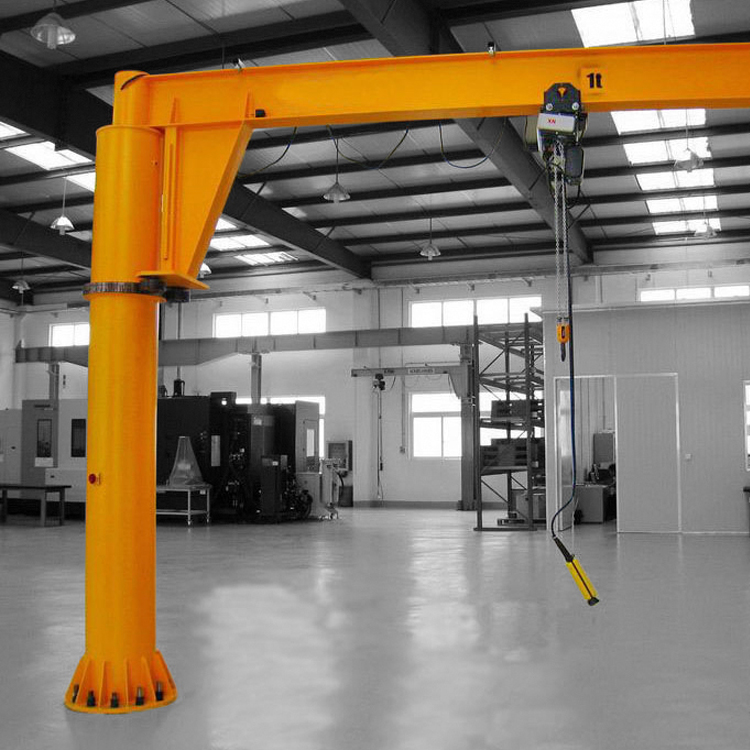
A jib crane is a compact lifting solution designed to move loads within a specific working area. Unlike large overhead cranes that cover an entire workshop, a jib crane is usually installed at a workstation, column, wall, or foundation and provides flexible lifting and positioning.
Jib cranes are widely used in manufacturing plants, warehouses, workshops, maintenance areas, loading stations, and assembly lines. They are especially useful when operators need to repeatedly lift and move materials over a relatively small area.
What Is a Jib Crane?
A jib crane consists mainly of a vertical support structure, horizontal jib arm, hoist, trolley, and control system. The jib arm can rotate around the supporting structure, allowing the operator to position loads within the crane’s working radius.
Depending on the installation method and working requirements, jib cranes can be designed as freestanding jib cranes, wall-mounted jib cranes, wall-traveling jib cranes, and portable jib cranes.
Jib cranes are commonly used for lifting relatively light or medium loads and can be customized according to lifting capacity, lifting height, working radius, and duty cycle.
Common Types of Jib Cranes
Different working environments require different jib crane designs.
1. Freestanding Jib Crane
A freestanding jib crane is installed on a foundation and does not depend on the building structure for support. It provides a large working radius and can be installed in different areas of a factory or warehouse.
This type is commonly used for:
- Production workstations
- Machine loading and unloading
- Assembly areas
- Maintenance operations
- Warehouse material handling
Freestanding jib cranes are a good option when an independent lifting station is required.
2. Wall-Mounted Jib Crane
A wall-mounted jib crane is attached directly to a building column or wall. Because it does not require a floor-mounted foundation, it can save valuable floor space.
It is suitable for lifting operations along production lines, workshop walls, and fixed workstations.
3. Wall-Traveling Jib Crane
A wall-traveling jib crane combines horizontal travel with jib rotation. The crane can move along a runway installed on the building structure while the jib arm provides additional rotation.
This design can provide greater coverage than a fixed wall-mounted jib crane and is suitable for production areas where several workstations need to be served.
4. Portable Jib Crane
Portable jib cranes are designed for applications where lifting equipment needs to be moved between different working areas.
They are useful for maintenance, equipment servicing, workshops, and temporary lifting operations where a permanent crane installation is not practical.
Advantages of Jib Cranes
Jib cranes provide several advantages for localized lifting applications.
Efficient Use of Space
A jib crane can be installed at a specific workstation and does not require the same large runway system as a conventional overhead crane.
Flexible Load Positioning
The rotating jib arm allows loads to be moved between different positions within the working radius, making material handling more convenient.
Easy Installation
Many jib crane designs have a relatively simple structure and can be installed independently or attached to an existing building structure.
Improved Workplace Efficiency
A jib crane can reduce manual handling and shorten the time required to move materials between nearby workstations.
Suitable for Repetitive Lifting
Jib cranes are particularly effective when the same lifting operation is performed repeatedly in a fixed working area.
Jib Crane Applications
Jib cranes are used across many industries because of their compact design and flexible operation.
Manufacturing
In manufacturing plants, jib cranes can move components, tools, molds, motors, and other materials around production stations.
Warehouses
A warehouse jib crane can be used for loading and unloading materials, handling machinery parts, and moving goods around individual workstations.
Maintenance Workshops
Jib cranes are commonly used to lift motors, pumps, gearboxes, and other heavy components during equipment maintenance.
Automotive Industry
They can assist with engine handling, component assembly, vehicle maintenance, and material positioning.
Steel and Metal Processing
Jib cranes can be used for localized handling of steel components, tools, and fabricated parts.
Loading and Unloading Areas
A jib crane installed near a loading station can help operators move materials between vehicles, storage areas, and workstations.
Jib Crane vs. Overhead Crane
Jib cranes and overhead cranes are both used for industrial material handling, but they are designed for different requirements.
| Feature | Jib Crane | Overhead Crane |
|---|---|---|
| Working area | Localized area | Large building area |
| Installation | Floor, wall, or column | Building runway |
| Coverage | Limited by jib radius | Wide coverage |
| Floor space | Compact | Minimal obstruction below |
| Typical loads | Light to medium | Light to very heavy |
| Best application | Workstations | General factory lifting |
A jib crane is usually a better choice when lifting is concentrated around one workstation or a limited area. An overhead crane is more suitable when loads need to be transported across a large workshop or warehouse.
How to Choose the Right Jib Crane?
Selecting the right jib crane requires more than simply choosing the required lifting capacity.
1. Determine Lifting Capacity
Identify the maximum load that the crane will regularly handle. Common jib crane capacities range from a few hundred kilograms to several tons, depending on the design.
2. Determine Working Radius
The jib length and required rotation angle determine the working area. Make sure the crane can reach all required lifting points.
3. Check Lifting Height
Consider both the required hook height and the available building clearance. The hoist and jib structure should not interfere with lighting, roof structures, or other equipment.
4. Consider Working Frequency
If the crane will be used continuously throughout the day, select an appropriate duty classification and hoist configuration for the expected workload.
5. Choose the Installation Method
The building structure and available floor space will determine whether a freestanding, wall-mounted, or wall-traveling jib crane is most suitable.
6. Consider the Working Environment
For outdoor or demanding industrial environments, the crane may require suitable corrosion protection, electrical protection, weather-resistant components, and other customized features.
Jib Crane Safety Features
Safety should be considered during both crane selection and operation.
Depending on the design, jib cranes can be equipped with features such as:
- Overload protection
- Emergency stop
- Upper and lower limit switches
- Travel limit switches
- Mechanical rotation stops
- Reliable brakes
- Safety hooks and lifting accessories
- Pendant or remote control
The crane should always be operated within its rated capacity and regularly inspected and maintained according to the applicable requirements.
Why Choose HY Crane for Jib Crane Solutions?
HY Crane provides industrial jib cranes for factories, warehouses, workshops, maintenance areas, and other material handling applications.
Jib cranes can be customized according to:
- Lifting capacity
- Lifting height
- Working radius
- Rotation angle
- Installation method
- Working class
- Hoist type
- Indoor or outdoor environment
HY Crane can also provide other lifting equipment, including overhead cranes, gantry cranes, electric hoists, electric winches, and transfer carts, allowing customers to select a suitable material handling solution for different areas of the same facility.
Conclusion
A jib crane is an efficient solution for localized lifting and material handling. Its compact structure, flexible rotation, and relatively simple installation make it suitable for manufacturing plants, warehouses, workshops, maintenance stations, and loading areas.
When choosing a jib crane, consider the lifting capacity, working radius, lifting height, duty cycle, installation method, and working environment rather than focusing only on the purchase price.
For a customized jib crane solution, contact HY Crane with your required lifting capacity, lifting height, working radius, and application details.
Jib Crane FAQs
What is a jib crane used for?
A jib crane is mainly used for localized lifting and positioning of materials around a workstation, production line, warehouse area, or maintenance station.
How much weight can a jib crane lift?
The lifting capacity depends on the crane structure, jib length, hoist, and application. Jib cranes can be designed for capacities ranging from light loads to several tons.
What is the difference between a jib crane and an overhead crane?
A jib crane normally serves a limited working area using a rotating arm, while an overhead crane travels along runway beams and can cover a much larger area.
Can a jib crane be used outdoors?
Yes. Outdoor jib cranes can be designed with suitable corrosion protection, weather-resistant electrical components, and other features required for the operating environment.
How do I choose a jib crane?
Consider the required lifting capacity, lifting height, working radius, rotation angle, working frequency, installation location, and environmental conditions before selecting a jib crane.
Post time: Aug-21-2026