



A jib crane is a compact lifting system used to move loads within a specific working area. Unlike an overhead crane that can cover a large section of a workshop, a jib crane is usually installed close to a workstation, machine, loading area, or production line.
Because of its relatively simple structure and flexible operation, jib cranes are widely used in factories, warehouses, workshops, maintenance areas, and loading stations.
What Is a Jib Crane?
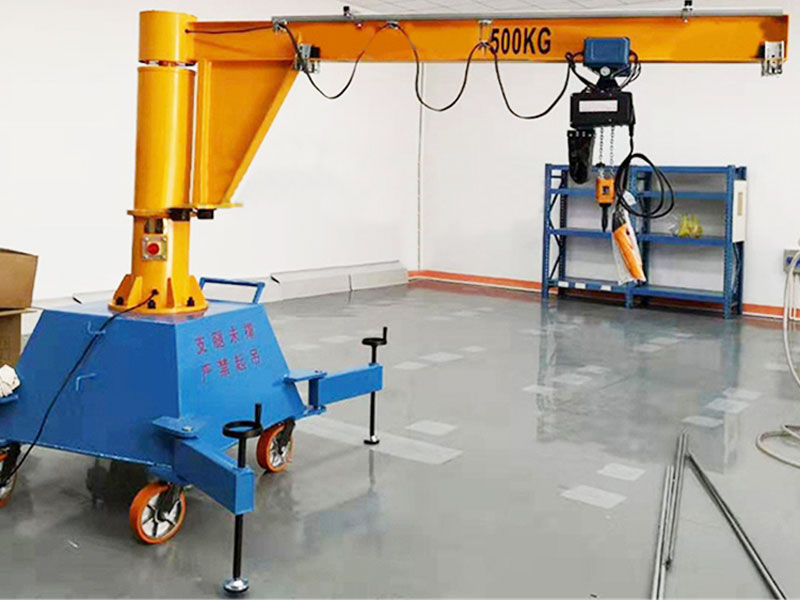
A jib crane normally consists of a vertical column or mounting structure, a horizontal jib arm, a hoist, and a slewing mechanism.
The hoist moves along the jib arm, while the arm rotates around its mounting point. This allows the operator to lift and position materials within a defined radius.
Depending on the installation method, jib cranes can be designed as:
- Floor-mounted jib cranes
- Wall-mounted jib cranes
- Pillar-mounted jib cranes
- Wall-traveling jib cranes
- Portable jib cranes
The right type depends on the available space, lifting capacity, and required working range.
Where Are Jib Cranes Used?
Jib cranes are often installed where loads need to be moved repeatedly between a few fixed positions.
Manufacturing Workshops
A jib crane can serve an individual production or assembly station. It can move motors, machine components, tools, molds, and other materials without requiring a full workshop crane system.
Machine Shops
Jib cranes are useful for loading and unloading machine tools. For example, a crane can move a heavy component from a pallet to a machining center.
Maintenance Areas
Maintenance workshops often need to remove and install motors, pumps, gearboxes, and other equipment.
A jib crane installed near the maintenance area can provide dedicated lifting capacity without occupying the whole workshop.
Loading and Unloading Areas
A jib crane can be positioned beside a truck loading area or warehouse door for handling smaller loads.
Warehouses
For localized material handling, a jib crane can complement an overhead crane or forklift and provide lifting coverage at a specific workstation.
Main Types of Jib Cranes
Floor-Mounted Jib Crane
A floor-mounted or pillar-mounted jib crane is fixed to the floor and can provide a relatively large working radius.
It is commonly used in factories, workshops, and assembly areas.
Wall-Mounted Jib Crane
A wall-mounted jib crane is attached to a suitable building column or wall structure.
It does not require a separate floor-mounted column, which can help save floor space.
However, the supporting structure must be checked to ensure it can safely carry the crane loads.
Wall-Traveling Jib Crane
A wall-traveling jib crane combines slewing movement with travel along a building wall or runway.
It can provide coverage along a longer production area than a fixed jib crane.
Portable Jib Crane
Portable designs can be moved between designated work areas.
They are useful when lifting locations change frequently, although capacity and mobility depend on the specific design.
How to Choose a Jib Crane
Selecting a jib crane starts with the actual lifting task rather than the crane model.
1. Lifting Capacity
Determine the maximum load that needs to be lifted.
Common loads include machine parts, motors, molds, pumps, tools, and production components.
2. Working Radius
The jib arm should cover the required lifting area. A longer arm provides a larger working radius but may also increase structural requirements.
3. Lifting Height
Check the required hook height as well as the available clearance below the roof, beams, doors, and other equipment.
4. Rotation Angle
Not every application requires a full 360-degree rotation.
Depending on the working area, the jib can be designed for a specific slewing angle or a full rotation.
5. Working Frequency
A crane used occasionally has different requirements from one operating continuously during every shift.
The hoist, motor, brakes, and structural components should match the expected duty.
6. Installation Conditions
For wall-mounted or column-mounted jib cranes, the supporting structure is particularly important.
The floor, foundation, building column, or wall must be able to withstand the loads generated during lifting and slewing.
Jib Crane vs. Overhead Crane
Both cranes are used for industrial material handling, but they serve different purposes.
| Feature | Jib Crane | Overhead Crane |
|---|---|---|
| Working area | Localized | Large workshop area |
| Installation | Floor, wall, or column | Building runway |
| Floor space | Small footprint | Mostly open floor |
| Typical use | Workstations | General material handling |
| Installation cost | Often lower for small lifting tasks | Higher for complete systems |
| Flexibility | Good for fixed workstations | Good for large-area handling |
A jib crane is often a practical choice when only one or several workstations require lifting equipment.
Jib Crane Hoist Options
The hoist is an important part of the jib crane system.
Depending on the load, lifting height, and working frequency, the crane may use:
- Electric wire rope hoist
- Electric chain hoist
- Manual chain hoist
Electric hoists are commonly selected for regular industrial lifting, while manual hoists can be suitable for lighter or occasional operations.
Control options may include pendant control and radio remote control.
Jib Crane Safety
Correct installation and operation are essential for safe jib crane use.
Important points include:
- Do not exceed the rated capacity.
- Make sure the load is properly attached before lifting.
- Keep personnel away from suspended loads.
- Check the jib structure, bolts, bearings, hook, and hoist regularly.
- Inspect the supporting foundation or structure.
- Avoid sudden lifting and excessive side pulling.
- Keep the slewing area clear during operation.
For wall- or column-mounted cranes, the supporting structure should be checked before installation.
What Affects Jib Crane Price?
The price of a jib crane depends on its configuration and installation requirements.
Major factors include:
- Lifting capacity
- Jib arm length
- Lifting height
- Rotation angle
- Hoist type
- Working class
- Installation method
- Control system
- Foundation or structural requirements
A 2-ton jib crane with a short arm for occasional lifting will have very different requirements from a heavy-duty crane with a long working radius and frequent operation.
Jib Crane Solutions from HY Crane
HY Crane provides jib crane solutions for factories, workshops, warehouses, maintenance areas, and other industrial applications.
The crane can be configured according to the required capacity, lifting height, working radius, rotation angle, hoist type, and installation conditions.
For a quotation, customers can provide the maximum load, required lifting height, jib length, working frequency, and installation location. Photos or drawings of the proposed installation area are also useful.
Conclusion
A jib crane is a practical lifting solution when materials need to be moved within a defined working area. It can be installed at production stations, machine shops, maintenance areas, warehouses, and loading points.
The key is to select the crane according to the actual job. Capacity, working radius, lifting height, rotation angle, duty, and installation conditions should all be considered before choosing the equipment.
FAQ
What is a jib crane used for?
A jib crane is mainly used for localized lifting and material handling around workstations, machines, maintenance areas, warehouses, and loading points.
What is the difference between a jib crane and an overhead crane?
A jib crane normally serves a specific working area, while an overhead crane can travel across a larger workshop or warehouse.
Can a jib crane lift heavy loads?
Yes. Jib cranes can be designed for different lifting capacities. The required capacity, working radius, and duty determine the appropriate configuration.
Can a jib crane rotate 360 degrees?
Some floor-mounted jib cranes can provide 360-degree rotation. Other designs may use a limited slewing angle according to the application.
What information is needed for a jib crane quotation?
The main information includes lifting capacity, lifting height, jib length or working radius, rotation angle, working frequency, hoist type, and installation conditions.
Post time: Sep-30-2026