



Warehouses handle a wide range of materials, from steel products and machinery to pallets, components, and heavy equipment. When manual handling or forklifts are no longer efficient, warehouse cranes can provide a safer and more efficient lifting solution.
Different warehouse layouts and lifting requirements call for different crane designs. Understanding the main warehouse crane types can help you select the right equipment for your facility.
What Are Warehouse Cranes?
A warehouse crane is a lifting system designed to move materials vertically and horizontally within a warehouse, workshop, storage facility, or production area.
Depending on the building structure and application, warehouse cranes can be installed on runway beams, supported by their own legs, or mounted to columns or walls.
The most common warehouse crane types include overhead cranes, gantry cranes, jib cranes, and monorail cranes.
1. Overhead Crane
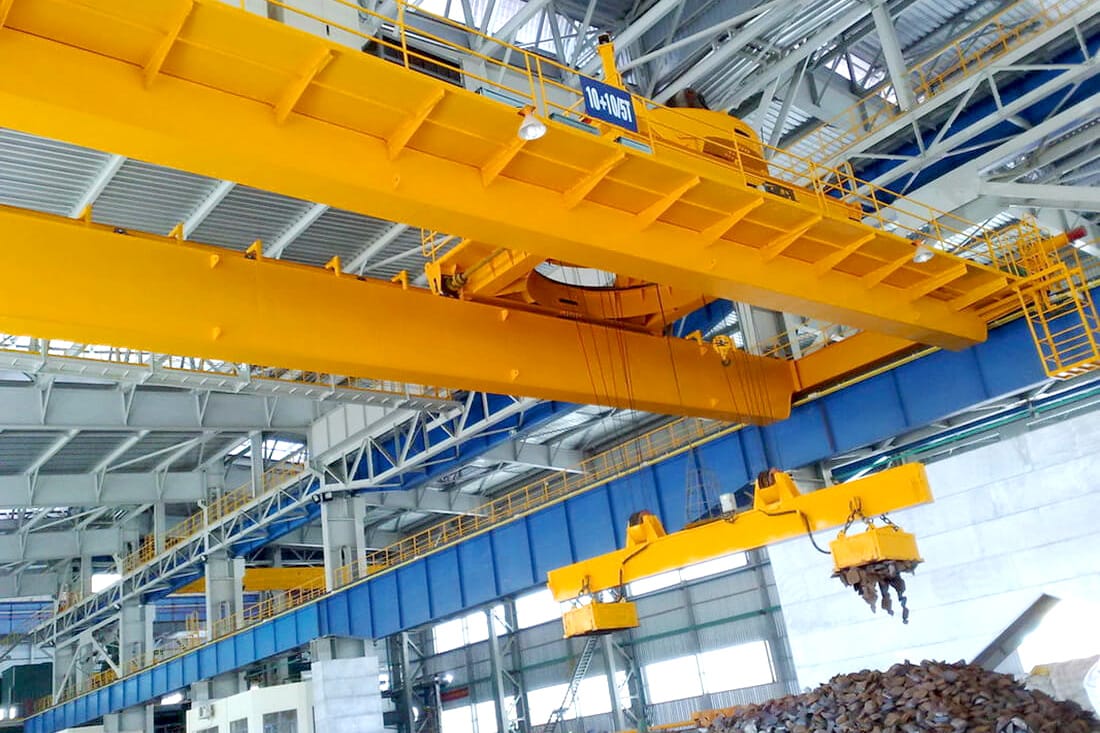
An overhead crane is one of the most widely used crane types for warehouses and industrial workshops. It normally consists of parallel runways, a bridge, end trucks, a hoist, and electrical control equipment.
Advantages of overhead cranes
- Efficient use of floor space
- Suitable for frequent lifting operations
- Available in single-girder and double-girder designs
- Can cover a large working area
- Suitable for different lifting capacities
A single girder overhead crane is often suitable for light- to medium-duty warehouse applications, while a double girder overhead crane is generally preferred for heavier loads, larger spans, or more demanding working conditions.
2. Gantry Crane
A gantry crane is supported by legs that run on rails or wheels instead of being suspended from the warehouse building structure.
Gantry cranes can be used both indoors and outdoors. They are particularly useful when the warehouse building cannot support a traditional overhead crane runway.
Typical applications include:
- Steel warehouses
- Precast concrete storage
- Machinery storage
- Construction material yards
- Large component handling
For warehouses that need flexible lifting coverage, a mobile gantry crane can also be considered.
3. Jib Crane
A jib crane is a compact lifting solution designed for a specific workstation or localized working area. It normally consists of a vertical column or wall-mounted structure and a horizontal jib arm.
Jib cranes are suitable when materials need to be repeatedly lifted and moved within a limited area.
Common warehouse applications include:
- Loading and unloading workstations
- Machine maintenance
- Assembly areas
- Parts handling
- Workshop material transfer
Compared with a full warehouse overhead crane, a jib crane usually covers a smaller working area but can be more economical for individual lifting points.
4. Monorail Crane
A monorail crane or monorail hoist runs along a fixed beam or track. Unlike an overhead bridge crane, it normally follows a predetermined route instead of covering the entire warehouse floor.
This makes it useful for repetitive material movement between fixed locations.
Typical applications include production lines, assembly areas, warehouses with defined material routes, and continuous handling operations.
How to Choose the Right Warehouse Crane Type?
Selecting a warehouse crane should be based on the actual lifting requirements rather than simply choosing the crane with the highest capacity.
Consider the following factors:
Load Capacity
Determine the maximum load that needs to be lifted. The crane should have sufficient capacity for the heaviest regular load while avoiding unnecessary oversizing.
Lifting Height
Measure the required lifting height and consider the available clearance between the crane, building structure, lighting, sprinkler systems, and stored materials.
Span and Working Area
The required span and coverage area can help determine whether an overhead crane, gantry crane, or localized jib crane is more appropriate.
Working Frequency
For warehouses with frequent lifting operations, an overhead crane with the appropriate duty classification may provide better long-term performance.
Building Structure
The existing warehouse structure is another important consideration. If the building can accommodate runway beams, an overhead crane may be a good choice. If structural modifications are difficult, a gantry crane can provide an alternative.
Warehouse Crane Types Comparison
| Crane Type | Best For | Main Advantage |
|---|---|---|
| Overhead Crane | General warehouse lifting | Large working coverage |
| Gantry Crane | Indoor/outdoor storage areas | Independent supporting structure |
| Jib Crane | Workstations and local lifting | Compact and flexible |
| Monorail Crane | Fixed material routes | Efficient repetitive movement |
Final Thoughts
The best warehouse crane type depends on your load capacity, lifting height, warehouse layout, working frequency, and building structure.
For general industrial warehouses, overhead cranes are often an efficient choice for covering large working areas. Gantry cranes are useful when independent support is required, while jib cranes and monorail systems are better suited to localized or fixed-route material handling.
HY Crane provides customized overhead cranes, gantry cranes, jib cranes, electric hoists, and other material handling equipment for warehouses and industrial facilities. By providing the required load capacity, span, lifting height, and application, customers can receive a crane solution matched to their warehouse requirements.
Post time: Aug-14-2026